Class A
Anno 1800
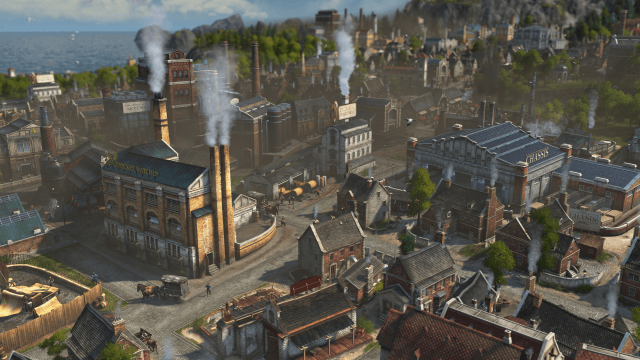
After its brief detour to apocalyptic future, the economic simulation series Anno returns to use a historical setting fully refreshed with Anno 1800.
The basic goal remains the same: explore an island world with your flagship, set an island starting with a simple warehouse, and develop the land into a metropolis through industry and transportation networks. Similarly to its brethren, The Settlers, you have to slowly expand your territory to make space for increasingly complicated production chains. But while in The Settlers the purpose of such industry is to support a strong army, Anno games focus on a more peaceful approach, that is, to fulfil the increasing needs of citizens in ever-growing cities as well as to trade with fellow governors and industrialists.
Unlike in previous Anno games, the world of Anno 1800 is divided into an old world and a new world, both of which provide different scenery, raw resources, and building options. The interplay between these regions is crucial to develop cities to their highest tier. Another addition to the series is the workforce, which is required for all industrial buildings. Therefore, both the growing of cities and the balancing of different citizen tiers have more vital role than previously. The game adds numerous new ways to optimise production, such as employing specialists, utilising propaganda in regularly published newspapers, and adjusting work hours in factories. Although at easier settings the game can be a soothing town builder, at higher difficulties such micromanagement becomes necessary, providing a very different experience.
With a good number of high-quality expansions available, the game can provide an enormous amount of complex yet smooth gameplay. Being the newcomer to a 20-year old franchise, Anno 1800 is truly exceptional.
Prison Architect
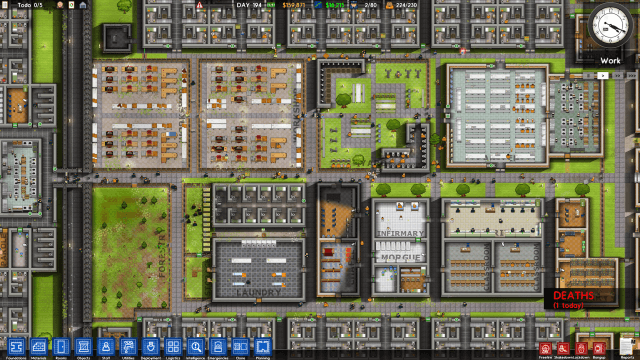
From the makers of the esteemed Uplink and Darwinia comes a prison-building simulator with excellent gameplay and distinguishable appearance. Just beware of its current owners…
The theme of the game is intriguing and surprisingly unique in the gaming world. The distinguishable cartoony look of the game lightens the dark subject matter just the right amount. Even better, the gameplay and the user interface are excellent. For such an open-ended game the replay value is rather high, considering the various starting options and optional challenges.
Unfortunately, after the game was shifted over to Paradox Interactive, it has been filled with mostly second-rate expansions and broken mechanisms. Thankfully, the original Introversion version is available, and it can still be recommended without any hesitation.
RimWorld
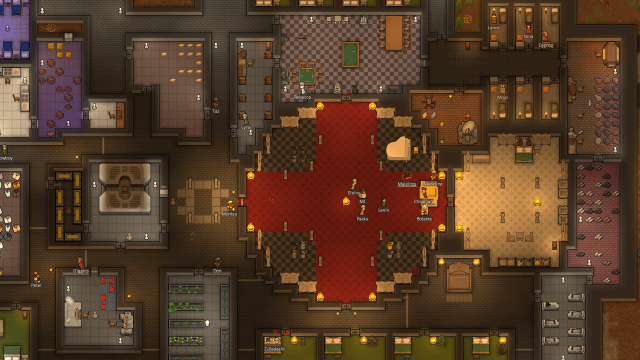
RimWorld brings Dwarf Fortress to a sci-fi setting, while challenging its precursor with impressive detail and quality as well as by delivering its own quirks and challenges.
Heavily inspired by Dwarf Fortress and other settlement survival games, RimWorld provides an atmospheric if occasionally rather violent experience. The aim of the base game is simple: build a thriving colony in a hostile alien planet, research new technology, and finally escape the dreadful place by a rocket. Hostile fauna, climate, and rival colonies ensure that fulfilling this goal will be a difficult and lengthy journey.
Ensuring the high mood of the colonists is critical to avoid devastating break spirals. This will not be an easy task considering the rich number of events, motives, and social interactions that affect their emotions. On the other hand, the priority mechanism that the colonists follow slavishly can lead to somewhat robotic behaviour. Thankfully, after the slow and nerve-racking early game, managing the individual colonists and the colony in general becomes a lot smoother experience.
However, the more prestigious the colony is, the more it attracts unwanted attention, and in the late game major battles become inevitable. In similar to its precursor, war injuries and other health conditions are described in meticulous detail. It is rare to see a game character with a lung cancer or liver cirrhosis.
The greatest flaw of the game is unfortunately one of its most advertised features. The so-called AI storytellers act too random in how they select the events that occur during a playthrough, and therefore it is once again the player's burden to actually create and tell the story. Nevertheless, the game does provide story-rich content, particularly with its many distinct expansions that cover elements of royalty, ideology, biotechnology, and even horror. And the numerous start preferences and in-game options make RimWorld accessible to many types of players.
Terraria
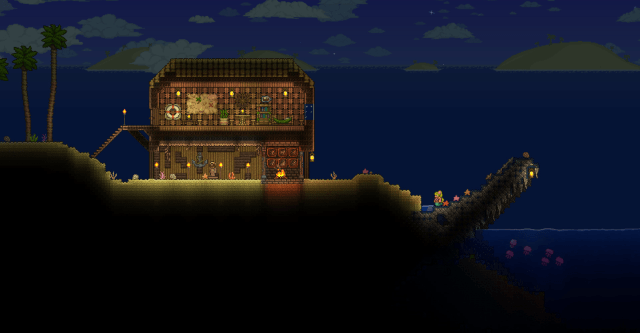
This gem from Relogic proves that a sprite-based 2D video game can become a millions-selling hit in these realism-heavy times.
In a nutshell, Terraria is an open-world action-builder. Most of the time will be spent on traditional platforming and fighting myriads of monsters augmented with semi-hidden class system. But as a modern twist the whole game world is interactable, demolishable and buildable. The graphical style reminds of the finest of the 16-bit era. The game excels at the sense of progression, with the player starting with a wooden sword in a middle of forest, ultimately becoming a unicorn-riding warrior-mage living in a self-built, well-earned castle. The world is dynamic with the ever-expanding biomes of Corruption and its opposite, the Hallow, keeping the player rather busy trying to keep the lands in balance. In fact, the player is kept busy throughout the game because of its almost never-ending content: there is dungeon crawling, mining for valuable minerals, building towns and luring villagers in, defeating bosses, and even golfing.
Terraria is a fine example of an independent game that was already impressive at the time of its initial release and over the years has only become more refined and richer.